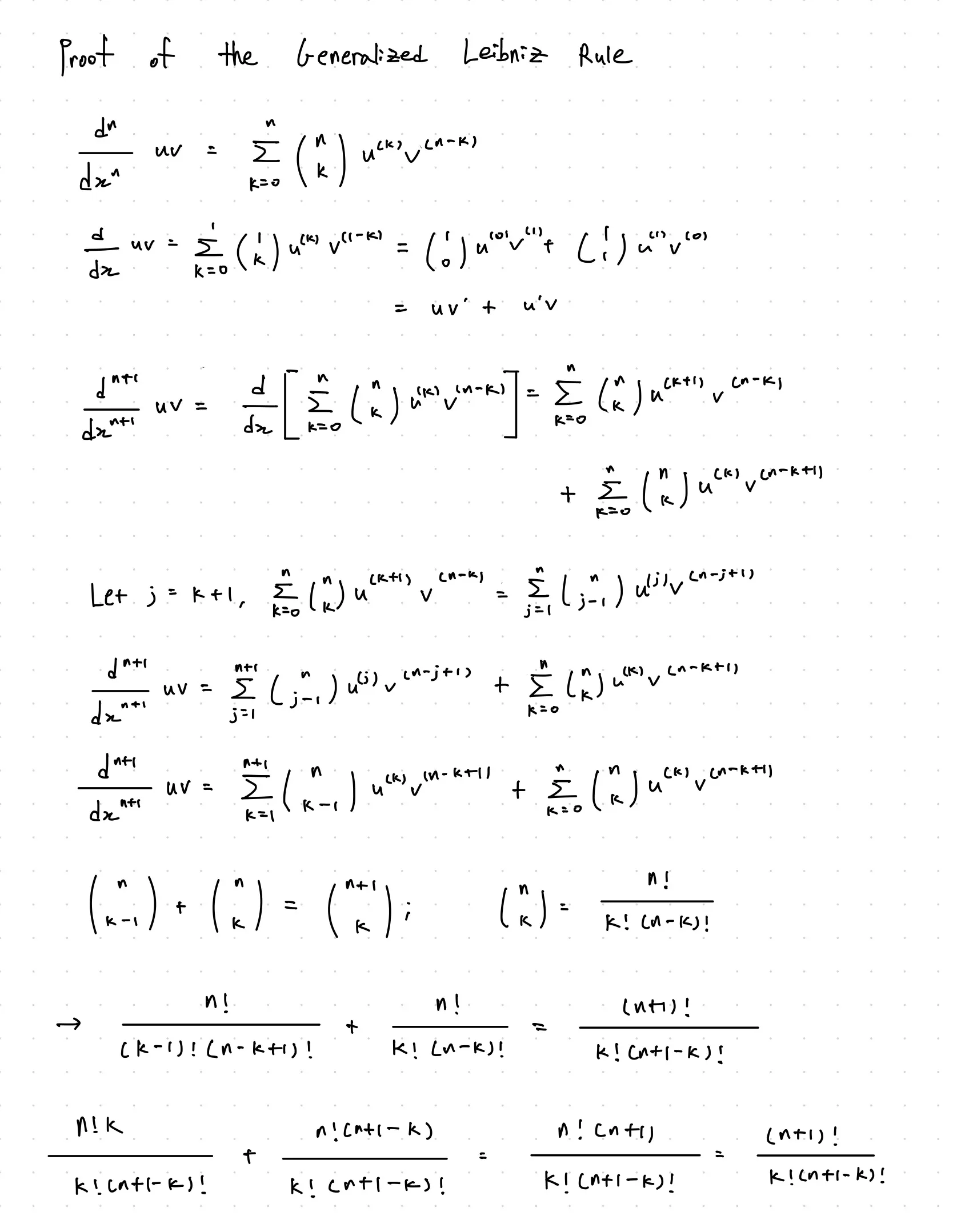
Let I be an interval, and let u,v:I→R. For every positive integer n, if u and v are n times differentiable on I, the generalized Leibniz rule states that
dxndn(uv)=k=0∑n(kn)u(k)v(n−k)
The proof proceeds by induction. The base case n=1 is the ordinary product rule:
dxd(uv)=u′v+uv′
For the induction step, let u and v be (n+1) times differentiable on I, and assume that the formula holds for some positive integer n. Each term on the right-hand side is then differentiable, so differentiating both sides and applying the product rule to each term gives
dxn+1dn+1(uv)=k=0∑n(kn)u(k+1)v(n−k)+k=0∑n(kn)u(k)v(n−k+1)
Reindexing the first sum by letting j=k+1, and then renaming j as k, gives
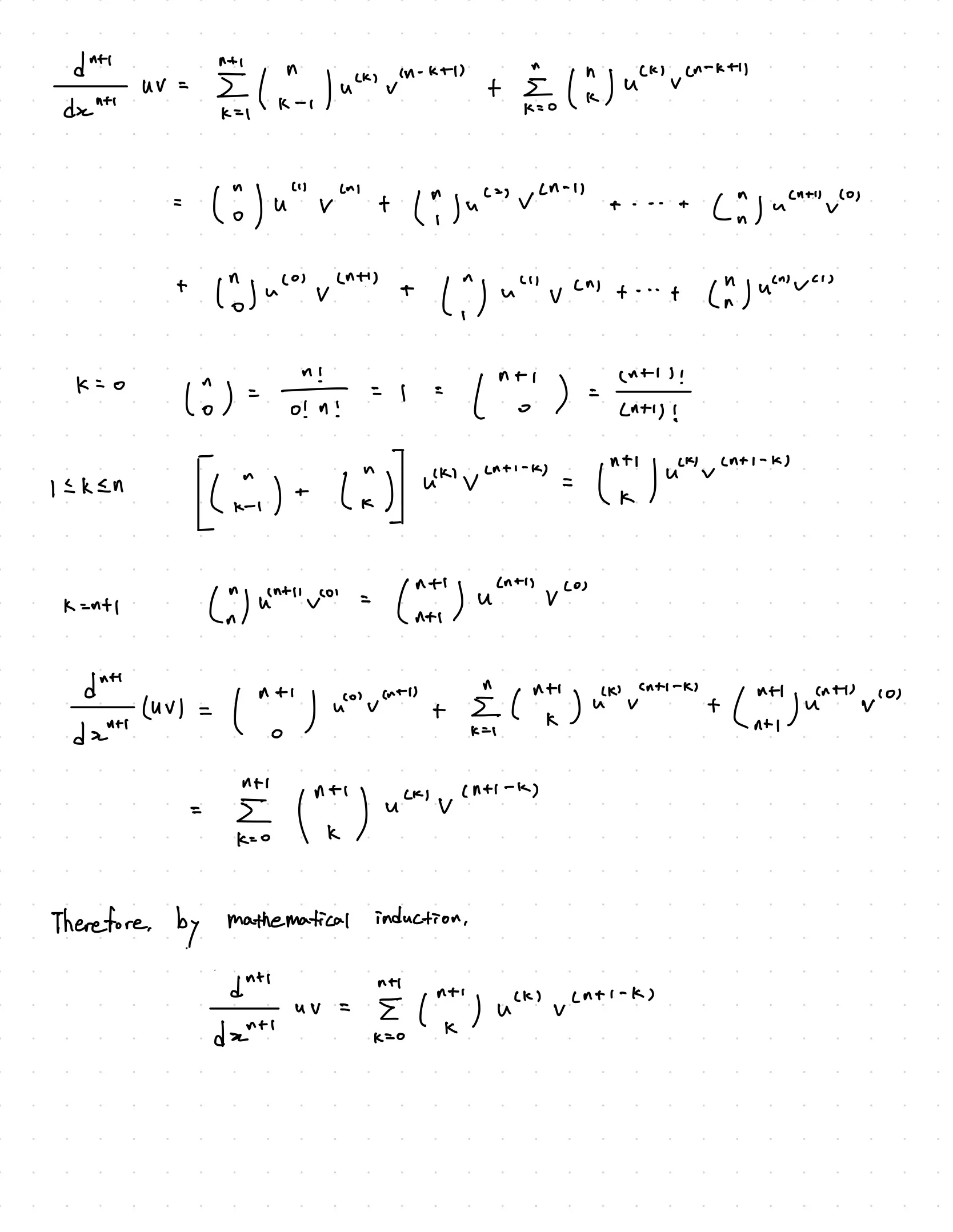
dxn+1dn+1(uv)=k=1∑n+1(k−1n)u(k)v(n+1−k)+k=0∑n(kn)u(k)v(n+1−k)
For the interior terms 1≤k≤n, Pascal’s identity gives
(k−1n)+(kn)=(kn+1)
The endpoint terms k=0 and k=n+1 also have the correct coefficients because
(0n)=(0n+1)=1
and
(nn)=(n+1n+1)=1
Therefore,
dxn+1dn+1(uv)=k=0∑n+1(kn+1)u(k)v(n+1−k)
Thus, by mathematical induction, the generalized Leibniz rule holds for every positive integer n.
AI Use Disclosure: AI assisted with drafting and refining the proof explanation.