Skip to content
신승민 | Seungmin's Blog
Go back

Calculating the Magnitudes of Three Position Vectors in a Cubic Structure

Updated:

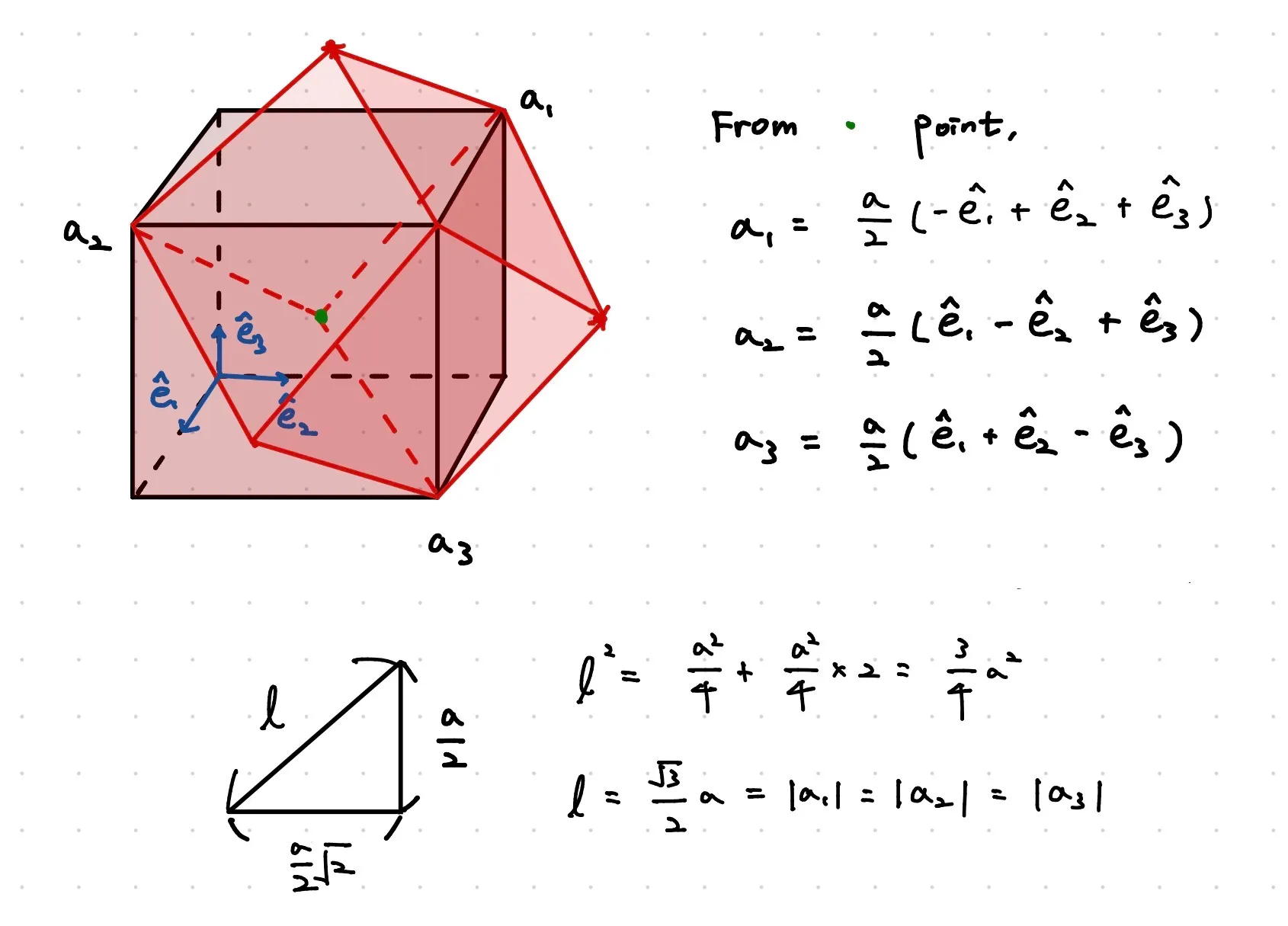
Cubic unit-cell diagram showing three position vectors, each with a magnitude of √3a/2

According to Wolfram MathWorld, Cartesian coordinates are rectilinear two- or three-dimensional coordinates. They are also called rectangular coordinates and a special case of curvilinear coordinates. The Cartesian unit vectors e^1\hat{e}_1, e^2\hat{e}_2, and e^3\hat{e}_3 point along the three mutually perpendicular coordinate axes. As shown in the figure, the position vectors are:

a1=a2(−e^1+e^2+e^3)a2=a2(e^1−e^2+e^3)a3=a2(e^1+e^2−e^3)\begin{aligned} \mathbf{a}_1 &= \frac{a}{2}(-\hat{e}_1+\hat{e}_2+\hat{e}_3)\\ \mathbf{a}_2 &= \frac{a}{2}(\hat{e}_1-\hat{e}_2+\hat{e}_3)\\ \mathbf{a}_3 &= \frac{a}{2}(\hat{e}_1+\hat{e}_2-\hat{e}_3) \end{aligned}

Because the Cartesian unit vectors are orthonormal and each position vector has three components with absolute value a/2a/2, all three have the same magnitude:

∣a1∣=∣a2∣=∣a3∣=a212+12+12=32a|\mathbf{a}_1|=|\mathbf{a}_2|=|\mathbf{a}_3| =\frac{a}{2}\sqrt{1^2+1^2+1^2} =\frac{\sqrt{3}}{2}a

Reference Video: https://www.youtube.com/watch?v=4-axgJJyd9g


Previous Post
Proof of the Generalized Leibniz Rule